

 LinkedIn
By December 31, 2027, no agency managing more than ten client retainers will still pay per tracked prompt for AI visibility software. The prompt cap, the per-seat add-on, the extra-model fee: all gone from serious agency plans. Write down the date. I intend to be checked on it.
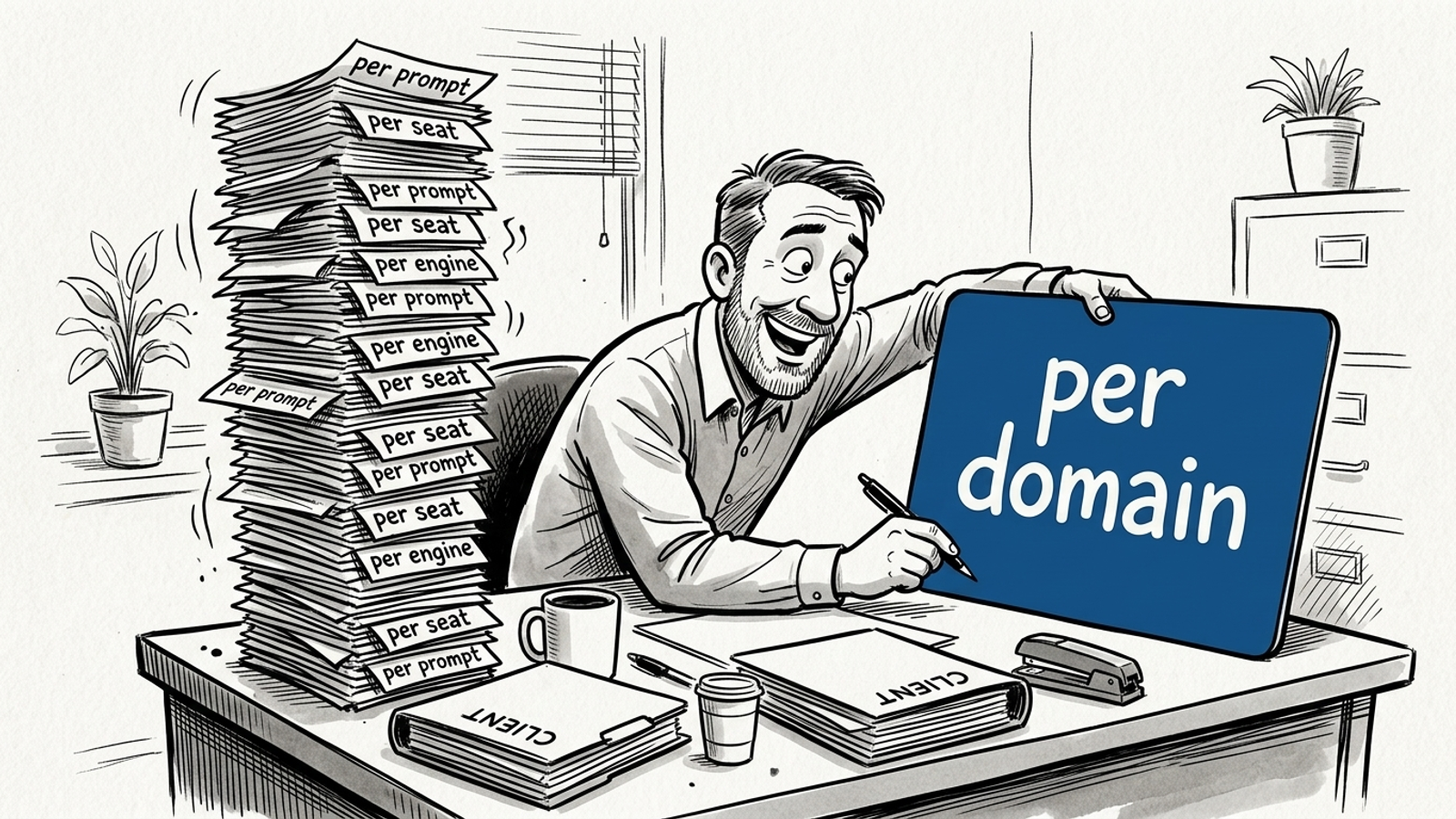
AEO software for agencies is replaying 2015 PPC pricing. Vendors charge by the tracked prompt for checks that cost fractions of a cent to run, then charge again for another domain, engine or seat. Agencies pass the bill along while their people still do the expensive work: rewriting pages, fixing technical blocks and earning citations. I have seen what happens when the fee survives after the work changes.
Here are my five calls. Prompt caps vanish. Flat per-domain execution becomes the norm. Monitoring-only tools get bundled or die. White-label AI SEO becomes a standard retainer line. Agencies that resell dashboards lose clients to agencies that resell outcomes. Each call has a mechanism, evidence available now and a way to prove me wrong.
Prediction 1: Tracked-prompt caps vanish by mid-2027
I spent years billing the old PPC way: percentage of spend, monthly check-in, a spreadsheet of bid tweaks I presented like strategy. For a while, that was honest work. Manual bids took hours, match types needed babysitting, and a client spending $20k a month could feel where the hours went. Then Smart Bidding ate the busywork and the fee stayed the same. I kept cashing 2015 checks for work the engine did for free. I was wrong to hold on as long as I did.
Prompt caps look like the same fee clinging to a shrinking task. Right now, Semrush charges $99 a month per domain for 25 tracked prompts, with another $60 a month for 50 more prompts and another $99 for each extra domain or seat. Otterly starts at $29 a month for 15 prompts and tops out at $489 for 400, with engines like Gemini or Claude as paid add-ons. Peec gives you 50 prompts for $95 a month but only three of six models. Ahrefs hands Lite users five prompts, Standard ten, Advanced twenty, then charges from $199 per index if you want the full picture.
For one brand tracking 200 prompts across five engines daily with three seats, one comparison puts the bill at $417 at Scrunch, $429 at Semrush, $638 at Otterly, $795 at Peec and $974 at Ahrefs. I ran shops with ten clients on retainer. Multiply any of those bills by ten before you decide the cap is a minor annoyance.
The mechanism is cost. A usage-priced tracker already lists about $0.002 per tracked prompt per platform. At that rate, 20 prompts checked daily on two engines for a month cost about $2.40 in credits. API checks keep getting cheaper; a price of $1 to $2 per prompt, with outliers from $0.39 to $9.98, gets harder to defend as buyers see the gap. I used to tell clients percentage-of-spend was fair because the labor scaled. Once engines automated that labor, it stopped being a good answer.
What proves me wrong? By July 2027, the leading trackers still enforce hard caps under 100 prompts on agency plans, and agencies keep paying overages without churning. If retention holds, buyers value the capped dashboard more than I think. Until then, treat prompt allowances as a contract risk, not a feature.
Prediction 2: Flat per-domain execution pricing becomes the default
Agencies already buy recurring work by the client site. Wholesale white-label SEO runs $99 to $349 per site with unlimited users, built to support $300 to $800 retail. Managed GEO retainers run $1,500 to $25,000 a month, with agency guides listing $3,000 a month at the low end and $5,000 to $8,000 for focused AI SEO programs. The gap between those numbers is mostly labor: people writing pages, fixing code and building citations one client at a time.
As that work gets automated, the domain becomes a more useful billing unit than the prompt. A prompt count tells the agency how often software checked an answer. A domain maps to the site where the work gets done and the client whose retainer must cover it. Agencies need to know their cost before a client asks for another report or adds a colleague to the account.
groas offers SEO and AI search for agencies at a flat monthly fee per client domain, with content, technical fixes, citations and weekly tracking under the agency brand. One connection covers the site, content system and citation work for that domain. That lets an agency quote a flat client line and protect its margin as the book grows, rather than watch a prompt meter eat the retainer. If your vendor charges more because a client wants three more questions tracked, you are buying measurement by the spoonful, not execution.
What proves me wrong? By late 2027, agencies still prefer prompt-metered plans at scale, while flat per-domain execution remains a niche offer. That would mean I misread what agencies want to put on an invoice. Ask for a per-domain delivery cost before you price the client’s retainer.
Prediction 3: Monitoring-only AEO tools get bundled or acquired
Most tools on the shelf were built to watch, not to fix. Peec does LLM monitoring well, Ahrefs correlates citations with backlinks, and Semrush fits existing workflows. But most tools were built as monitoring products and hand the work back to humans. The dashboard shows where a client stands; somebody else still has to decide what changes and ship them.
That split works while tracking feels scarce. It looks less attractive when checks are cheap and the agency is paying separately for the labor that follows. A tab showing that a client dropped from 12% to 9% share of voice in Perplexity does not rewrite the page, publish the comparison or earn a citation by Friday. The deck calls the tab visibility. I call it a screenshot with a subscription.
Cheap monitoring gets absorbed into the workflow that acts on it. Standalone trackers will add execution, get bundled into broader suites or get bought for their data. Some may keep loyal users, but an agency trying to defend a retainer needs more than a record of what went wrong. It needs a record of what changed afterward.
What proves me wrong? Independent trackers keep growing at current prices through 2027 without adding execution. If agencies keep paying $400-plus a month just to watch, I have overestimated how much they hate doing the work twice. For now, do not sign a two-year deal for a thermometer when you need a furnace.
Prediction 4: White-label AI SEO becomes a standard retainer line
By the end of 2027, the line marked AI visibility on an agency invoice will not be a pilot or an occasional upsell. It will sit next to SEO and paid media on standard retainers, fulfilled white-label and priced per domain. Clients already ask where they show up in ChatGPT and Google AI Overviews. Agencies already know the wholesale model: buy unbranded fulfillment, sell it within the client relationship and remain accountable for the work.
groas runs that model with reports under the agency brand and a strategist who stays behind the agency team. Fulfillment and reporting are already separated. That means an agency can add AI search with one supplier line rather than one new hire, while keeping a clear owner for the client conversation. White-label only works if there is work behind the label. A prettier report does not make an unchanged page more useful or fix a technical block.

This will not work for everyone. If you sell one-off audits, skip white-label execution; you take on support cost without recurring revenue. If you sell monthly SEO, the pressure to include AI visibility is harder to avoid. My checkable version: by Q4 2027, more than half of agencies selling SEO retainers list AI visibility or GEO as an included line rather than a separate product.
What proves me wrong? White-label AI SEO remains confined to custom $5,000-plus projects with named specialists. In that case, execution has not become cheap enough to fit the standard retainer, and I misjudged the labor curve. Sell the outcome, fulfill per domain and keep your name on the report.
Prediction 5: Dashboard resellers lose to agencies that ship work
I have sat in that renewal meeting. The client stares at a share-of-voice chart, asks what changed in revenue, and the account manager talks about prompt coverage. Everybody understands the chart. Nobody wants to pay another year for the same explanation.
Say you charge $2,000 a month and $400 of it goes to a tracker plus four hours pulling screenshots. The agency down the street charges the same $2,000, shows logged fixes every week and ties the work to calls and pipeline. Both agencies can spot a drop in citations. Only one ships the new pages and technical fixes intended to bring them back. That is the mechanism: once monitoring is available to both, the difference the client can see is what happened after the alert.
Clients do not renew charts. They renew booked jobs. That does not make measurement optional. It makes measurement the beginning of the account conversation rather than the deliverable at the end. A useful report should let the client see what changed, why the agency changed it and whether the work is moving toward the outcome the retainer was meant to support. Prompt coverage alone cannot carry that conversation.
What proves me wrong? Dashboard-only resellers keep their net revenue retention through 2027 while execution shops have to discount to win. Then buyers wanted proof of work less than I thought. Until then, move the AEO budget from screenshots into delivery before a competing agency does.
Buy for the repricing before you reprice your clients
If these calls are right, the worst contract you can sign now is a 12-month tracker billed per prompt, per engine and per seat. I would buy as though the repricing has already started. Put four filters on any software you plan to build into a retainer:
- Month-to-month with no lock-in. If the vendor needs a year to keep you, look hard at the price.
- No prompt caps or overage meters. Tracking 30 prompts instead of 300 should not require a call to finance.
- Flat per-domain pricing across the book. One client domain should mean one predictable cost, whether you manage five clients or fifty.
- Logged execution, not just monitoring. Each week, you should be able to see what pages shipped, what technical blocks were fixed and what happened with citations, with the reasoning attached.
Start with one client before you reprice the book. Put the new model on a mid-size retainer, run it for 30 days and compare three things: software cost per domain, hours your team spent on fulfillment, and what you can show the client without leaning on a screenshot. groas offers a seven-day test on one real client account before an agency pays, then per-domain pricing for SEO and AI search under the agency brand. If delivery hours fall and you have work worth reporting, roll it to the next nine clients. If not, you learned that on one domain rather than ten.
The 2027 scorecard
Pin these calls and check them against their dates. The July prompt-cap test is an early signal; the full prediction runs through December 31, 2027. I am not moving the goalposts afterward. If three of five hit, the repricing happened. If four hit, the per-prompt model is dead for agencies. If none hit, I will write the correction and name what I missed about buyer behavior.
- Prompt caps: By July 2027, the top five agency trackers no longer enforce hard caps under 100 prompts or charge overage per prompt.
- Per-domain execution: By the end of 2027, a flat per-client-domain price is the standard quote for agency AEO fulfillment, rather than a stack of prompt, seat and engine fees.
- Bundling: By the end of 2027, at least two standalone monitoring tools have added execution, been bundled into a suite or been acquired.
- White label: By Q4 2027, most SEO retainers you compete against list AI visibility as an included line fulfilled under the agency brand.
- Outcomes: Through 2027, agencies showing logged fixes tied to pipeline renew at higher rates than agencies forwarding share-of-voice screenshots.
Buy month-to-month, price per domain and insist on logged execution. Then, if I am right, you will not have to explain to ten clients why your software bill went up while the work stayed the same.